Metadata
Title
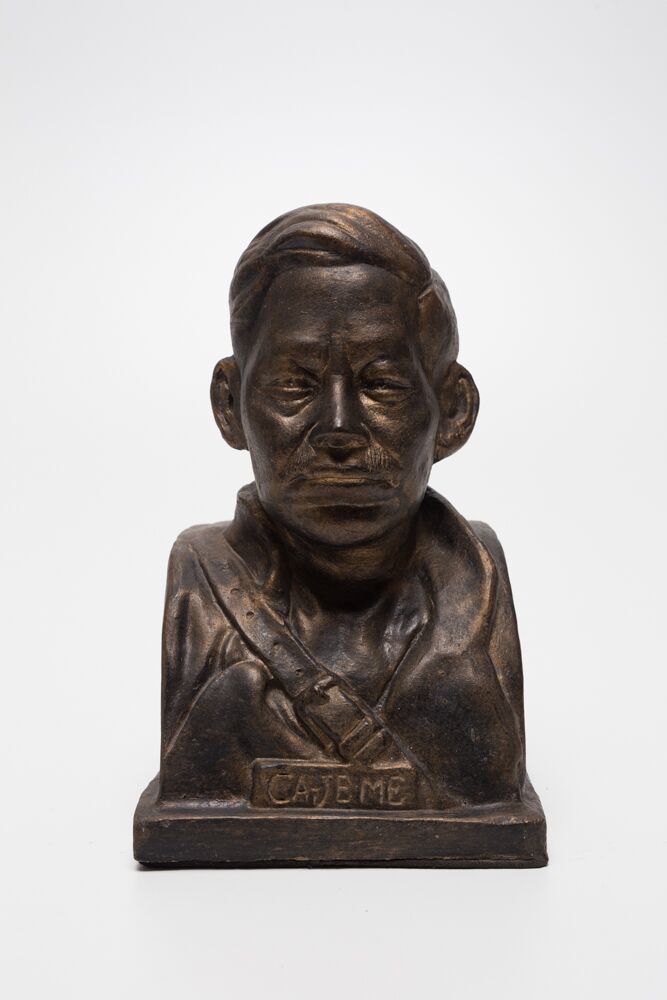
José María Leyva "Cajeme"
Creator
Pacheco Martínez, Julio de Jesús
Created
1985
Type
Description
1 sculpture
Description
In 1874, after serving eight years in the Mexican military, he was recognized by the Sonoran authorities, so they appointed leader of the Yaqui and Mayo tribes (Hernández, 2017). A year later, Cajeme emerges as a defending leader of the Yaqui people, to prevent them from being dispossessed of their lands. From then on he cunningly led the Yaqui people for seven years, during which several conflicts arose. One of those struggles came against the powerful of the state, due to their acquisition of more land concessions in 1882, a reason that encouraged the Yaquis to respond with arms on October 15 in the battle of Capetayama. The results were the withdrawal and dispersal of state forces and the subsequent resignation of Ortiz (who had been the main culprit in starting this uprising) as governor.
There was a period of truce that lasted two years from 1883 to 1885, however, in 1885 there was a failed assassination attempt on Cajeme by his former lieutenant Loreto Molina. Cajeme then petitioned the new governor Luis E. Torres for Molina's punishment, threatening to retaliate if it did not happen, but the governor did not support Cajeme's demands. Therefore, Cajeme initiates acts of revenge, among which are the burning of the commercial vessels that sailed on the river, as well as the attack on haciendas near the borders of Yaqui territory.
The force of the army did not wait and launched a strong military campaign against Cajeme, developing confrontations in the Fort known as” El Añil,” located on the banks of the Rio Yaqui, between the towns of Vícam and Pótam, where the federal forces were withdrawn. As in any war, wear and tear began to be an important factor, and the differences between the indigenous leaders by 1886 were becoming more acute, which is why Cajeme's leadership was diminishing. But the most intense moments of the war were yet to come, since during the first five months of that year there were more than 100 battles, forcing Cajeme to withdraw to the Bacatete mountains, where the situation became unsustainable, which caused many tribal members to lay down their arms. Except for a few leaders, that further prolonged the battles with guerrilla war tactics.
However, the few who continued to fight could not bear the ravages, Cajeme had no choice but to ask for an egalitarian peace, one that would not denigrate his people and, above all, that they respect Yaqui autonomy, but to no avail, the government never agreed to the terms. Cajeme tried to continue in the insurrection, but hunger, courage and physical exhaustion made his followers succumb, who had no choice but to surrender. Thus ended a stage of the rebellion that he had led for more than 10 years. On April 12, 1887, Cajeme, trying to hide, was captured, being killed on the way to his cell in Cócorit, applying the famous "vanishing law" in a place known as the three crosses. (Moreno, 2010).
Subject
Indigenous leaders--Sonora (Mexico : State) | Mexico--History--1867-1910 | Sculpture--Mexico--Ethnic groups | Yaquis--History--Wars
Format
Still image / jpg
Spatial
Sonora , Cócorit
Temporal
1981 -1990
Is part of
Historical room, Museum of the Yaqui people
Provenance
Museum of the Yaqui people. Sinaloa and Obregon No. 200, Cocorit, Cajeme, Sonora
It has been part of the museum's collection since its creation in 1985.
Language
eng , yaqui
Date
2022-03-01
Identifier
WEB CATALOGACION OBREGON 2016-2821 | RS-OM-MEY-82
Relationship
References
Moreno Romero, Humberto. (2010). Las rebeliones Yaquis en el Porfiriato En: Horizonte Histórico. Revista de Historia de la Universidad Autónoma de Aguascalientes. Año 2 (3). Disponible en: https://revistas.uaa.mx/index.php/horizontehistorico/issue/view/103/79
García Rivera, Edna L. (2020). Historia y memoria en torno a liderazgos indígenas: narrativas de las mujeres yaquis En Región y sociedad. Año 32. Disponible en: http://www.scielo.org.mx/pdf/regsoc/v32/1870-3925-regsoc-32-e1327.pdf
Hernández Salomón, Manuel. (2017). El legendario Cajeme: el misterioso líder guerrero de los yaquis en el siglo XIX. En Relatos e historias en México. (109)
Contributor
Sonoran Institute of Culture
Casanova, Juan (photography)
Buitimea Flores, Teodoro; Ruiz Félix, José María (investigation)
Valencia, Carlos ; The Yaqui Pride Project (translation to english)
License

This work is licensed under a Creative Commons Attribution-NonCommercial-ShareAlike 4.0 International License.
Rights
Sonoran Institute of Culture