Metadata
Title
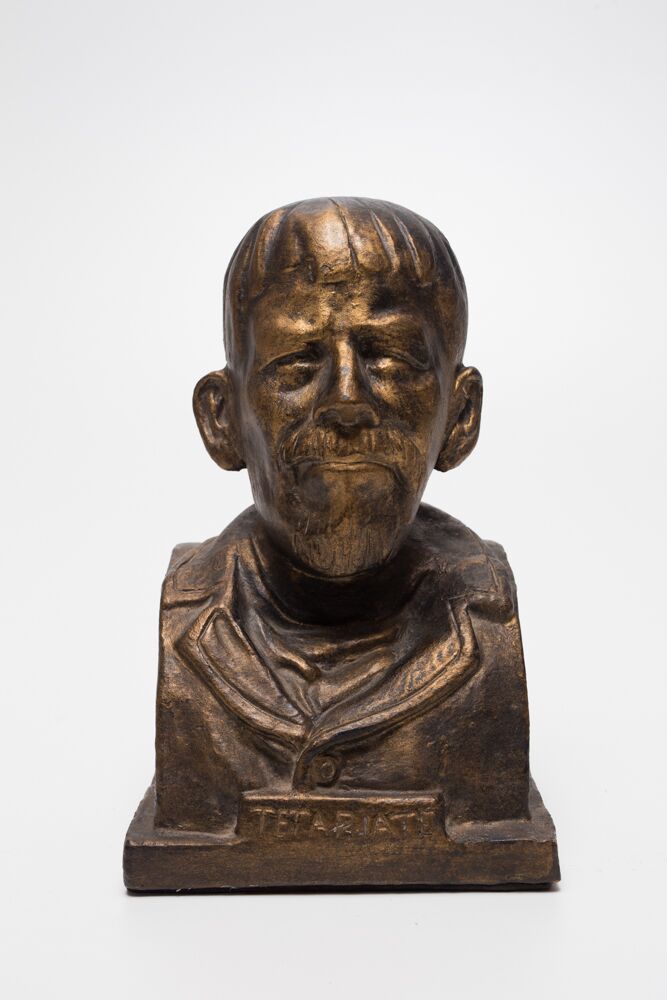
Juan Maldonado Waswechia "Tetabiate"
Creator
Pacheco Martínez, Julio de Jesús
Created
1985
Type
Description
Original object (physical):
Dimensions: 29 X 17.4 X 15 cm.
Plaster modeling technique with a bronze-like finish on its surface
Description
Bust-type sculpture, made by the local sculptor and historian, Dr. Julio de Jesús Pacheco Martínez. The materials used were molded plaster and imitation bronze finishes, alluding to the Yaqui leader Juan Maldonado Waswetchia commonly called Tetabiate (rolling stone).
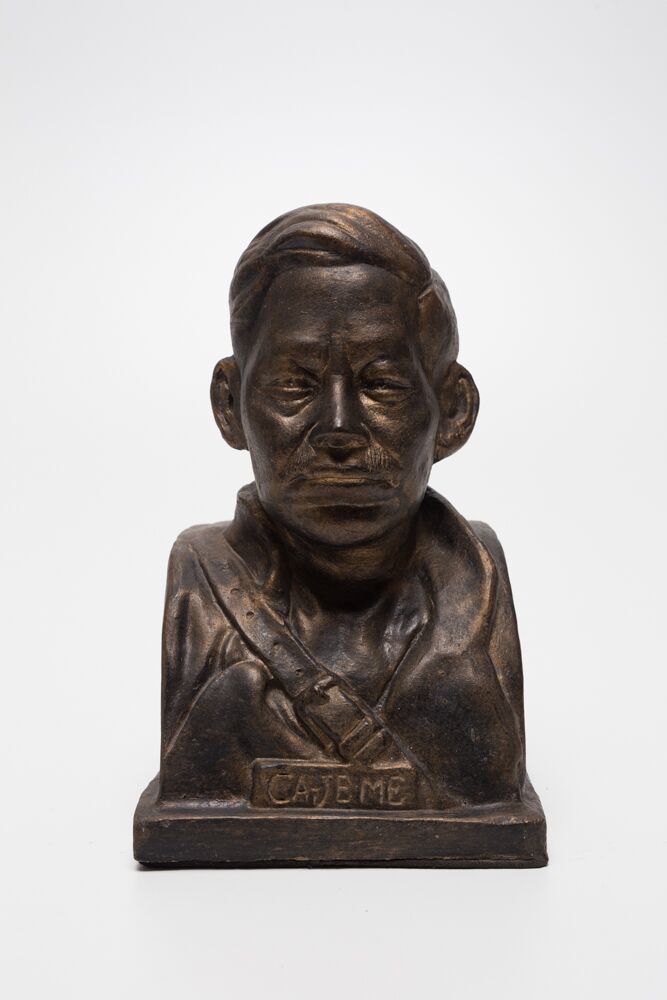
He was one of the most important political and military leaders of the Yaqui tribe in the war they waged against the Mexican army during the period of the Porfirista dictatorship. He took over leadership of the Yaquis after Cajeme's death in 1887; His leadership was considered one of the most charismatic due to the fact that he only spoke the Yaqui language and was not chosen by the state authorities (García, 2020).
According to Moreno (2010) and García (2020), the movement led by Tetabiate was characterized by fighting the army through guerrilla warfare, the form of operation was to hide in the Sierra de Bacatete where it avoided the concentration of troops and made it difficult to enemy maneuvers; in his insurrection, the help of “meek” Yaquis was vital for the supply of the troops formed by “broncos” Yaquis. Thanks to this, Tetabiate managed to stay in the fight for around 14 years, until the beginning of the 20th century.
Moreno (2010) indicates that in 1896 Governor Luis E. Torres showed signs of negotiation to end the war peacefully, an impulse for which Tetabiate, perhaps already tired of the constant struggle, agreed, and a year later an agreement was signed known as "peace of Ortíz", however, the government did not withdraw the army from the Yaqui territory and added to this, the constant process of colonization of the entire valley was added, originating a new uprising.
Tetabiate led the movement, but not his former lieutenant Loreto Villa, who joined the state militia. Juan Maldonado had no choice but to return to shelter in the mountains where the clashes continued until July 10, 1901, when Tetabiate was killed by Loreto in a verified combat on the Mazocoba hill; it became such a complex and costly resistance to the Porfirista government that it led to the mass deportation of Yaquis to other areas of the country, such as those exiled to Oaxaca and Yucatán.
The remains of Tetabiate are found in the Sierra del Bacatete, next to the Fort of the Mexican Army; in front of the town of Pithaya (traditionally town of Bethlehem).
Subject
Indigenous leaders--Sonora (Mexico : State) | Mexico--History--1867-1910 | Sculpture--Mexico--Ethnic groups | Yaquis--History--Wars
Format
Still image / jpg
Spatial
Sonora , Cócorit
Temporal
1981 -1990
Is part of
Historical room, Museum of the Yaqui people
Provenance
Museum of the Yaqui people. Sinaloa and Obregon No. 200, Cocorit, Cajeme, Sonora
It has been part of the museum's collection since its creation in 1985.
Language
eng , yaqui
Date
2021-11-14
Identifier
Web Catalogación Obregón 2016 - 2823
ISC-CGPC-MY-0045
RS-OM-MEY-45
Relationship
References
Moreno Romero, Humberto. (2010). Las rebeliones Yaquis en el Porfiriato En: Horizonte Histórico. Revista de Historia de la Universidad Autónoma de Aguascalientes. Año 2 (3). Disponible en: https://revistas.uaa.mx/index.php/horizontehistorico/issue/view/103/79
García Rivera, Edna L. (2020). Historia y memoria en torno a liderazgos indígenas: narrativas de las mujeres yaquis En Región y sociedad. Año 32. Disponible en: http://www.scielo.org.mx/pdf/regsoc/v32/1870-3925-regsoc-32-e1327.pdf
Contributor
Sonoran Institute of Culture
Casanova, Juan (photography)
Buitimea Flores, Teodoro; Ruiz Félix, José María (investigation)
Valencia, Carlos ; The Yaqui Pride Project (translation to english)
License

This work is licensed under a Creative Commons Attribution-NonCommercial-ShareAlike 4.0 International License.
Rights
Sonoran Institute of Culture